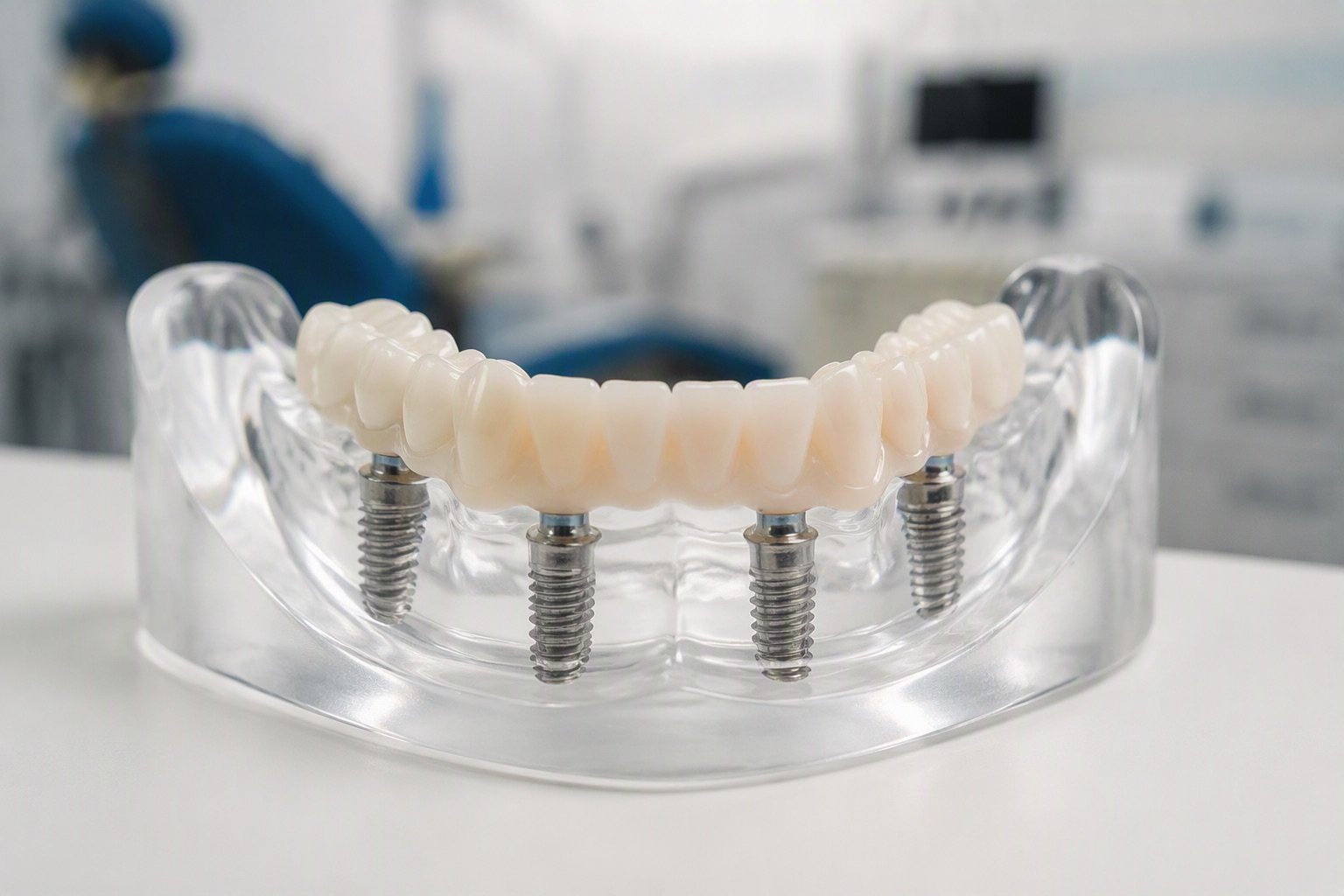
Toronto Bridge and All on 4 are often confused, and not surprisingly: both rehabilitate an entire arch with one fixed prosthesis screwed onto implants. But they are not the same thing: All on 4 is a implant protocol (4 implants, the posterior ones inclined), while Toronto Bridge is a type of prosthesis (titanium structure with resin flange). In this guide we put things in order with a complete comparison table: aesthetics, hygiene, duration and cost.
The distinction that clarifies everything
All on 4 indicates the surgical technique: four implants per arch, the two rear ones inclined to exploit the available bone and avoid grafts. A Toronto Bridge (prosthesis with resin flange) or a ceramic prosthesis without flange can be screwed onto these 4 implants.
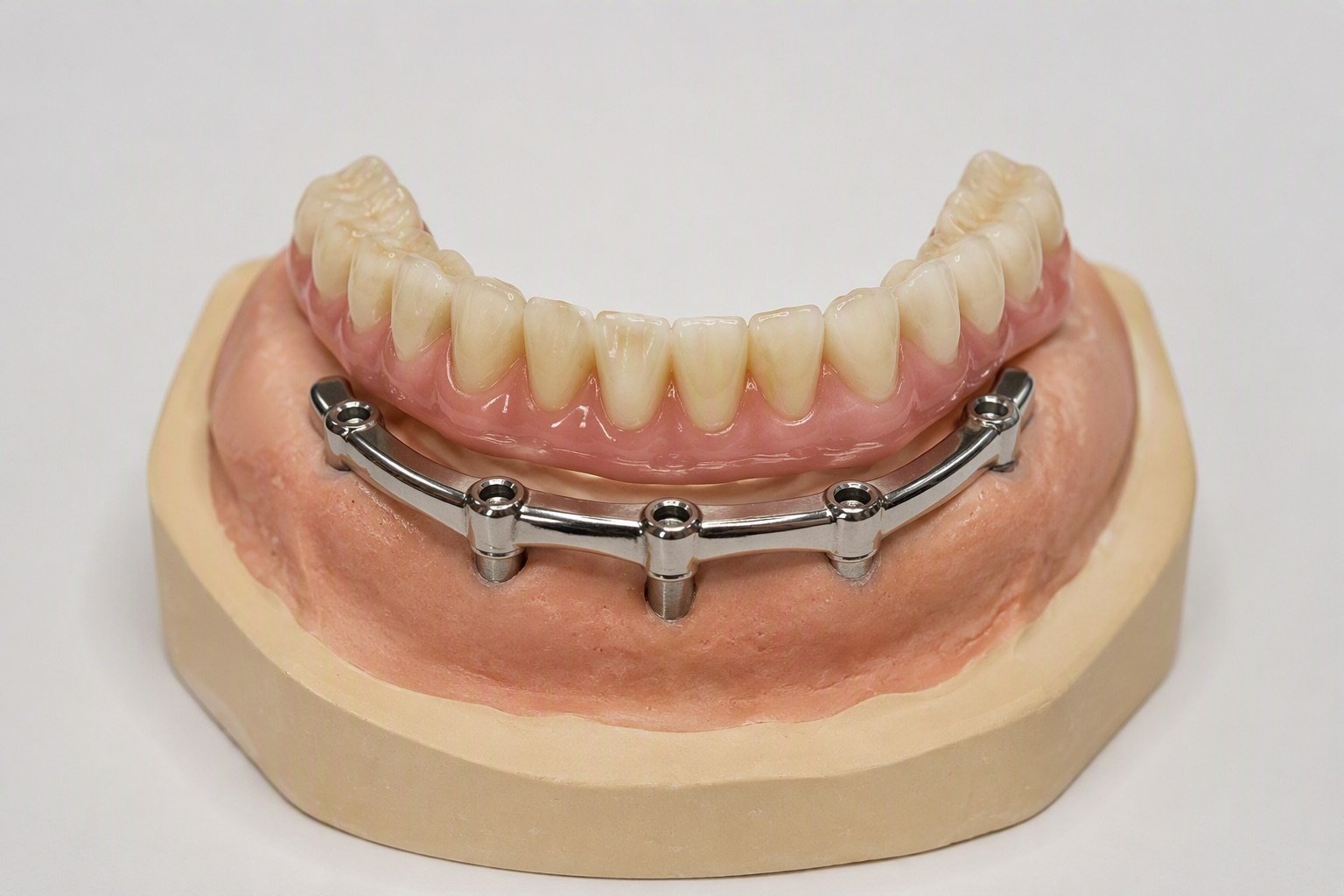
Toronto Bridge indicates the prosthesis: titanium frame, resin/composite teeth, pink artificial gum (flange) covering the area where the bone and gum have receded. It can be fixed on 4 implants (All on 4), on 6 (All on 6) or with a bar.
So the correct question is not “Toronto or All on 4" but: "how many implants are needed in my case, and what type of prosthesis do we screw onto them?". Learn more about the two techniques on the pages Toronto Bridge e All on 4.
Complete comparison table
| Feature | Toronto Bridge (with flange, resin) | All on 4/6 ceramic prosthesis (without flange) |
|---|---|---|
| Implants | 4 or 6 | 4 or 6 (requires more bone for the flangeless version) |
| Artificial gingiva (flange) | Yes: it covers bone and gum recession | No: you need sufficient bone/gingiva or reconstruction |
| Teeth material | Resin/composite (more elastic, wears out sooner) | Ceramic/zirconium (more aesthetic and wear-resistant) |
| Aesthetics | Excellent; the flange solves "long" smiles | Excellent if the fabrics are adequate |
| Home hygiene | Water flosser and pipe cleaners under the flange | Similar to natural teeth, superfloss floss |
| Reparability | Easy and economical in the laboratory | More complex and expensive repairs |
| Wear over time | Relining or replacing teeth after 5-10 years | Minimal wear, longer life of the product |
| Average cost in Italy (arch) | €8.000 – €15.000 | €10.000 – €18.000 |
| From Sanitadental Clinic (arch) | from €2,800 to €4,500, depending on the case | from €3,500 to €4,500, depending on the case |
Italian prices = indicative market averages; our quote is written, signed and blocked for 30 days.
When the flange is an advantage (not a defect)
After years of edentulism or periodontal disease, the bone and gums recede: a "teeth only" prosthesis would result in very long and unsightly teeth. The pink resin flange of Toronto reconstructs the gingival profile and restores natural proportions to the smile and lips — often with an aesthetic support effect on the lower third of the face that patients greatly appreciate.
For this reason, in the event of a marked reabsorption, the Toronto Bridge is not the "economic choice": it is the technically correct choice. Ceramic without flange, on the other hand, is ideal when the tissues are well preserved.
Hygiene and maintenance compared
With the Toronto the cleaning passes below the prosthesis: daily water flosser, pipe cleaners, superfloss thread. It's simple but must be done consistently. With ceramic without flange, cleaning is more similar to that of natural teeth.
In both cases they are useful professional checks 1-2 times a year with removal of the prosthesis (the Toronto is easily unscrewed) and professional hygiene. The resin can be restored in the laboratory at little expense; ceramic lasts longer but, if chipped, it costs more to repair.
Which one to choose: the clinical criteria
The choice comes from the CT scan and tissue examination: marked bone resorption → Toronto with flange; well-preserved fabrics and maximum aesthetic request → ceramic without flange; poor posterior bone → 4 inclined systems; good bone and high forces → 6 systems. We present both options when appropriate, with prices and future maintenance written in black and white. Request a free x-ray evaluation from the page contacts — and remember that the expense is tax deductible in Italy.